
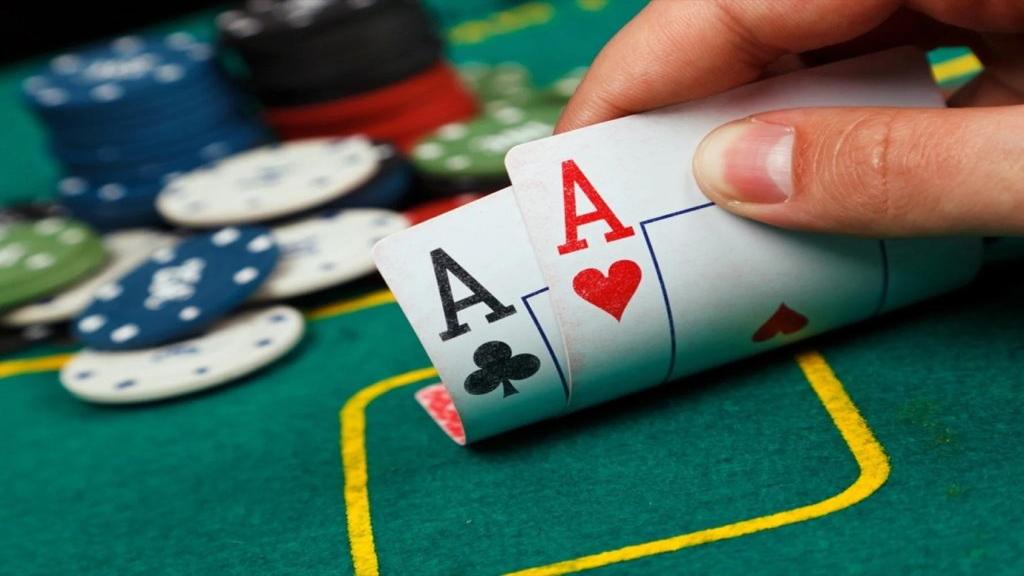
Poker is a game that is easy to learn but can take years to master. The basic rules can be understood in a short time, but making consistently good decisions requires practice, patience, and an understanding of probability and strategy.
For beginners, the biggest challenge is often knowing what to do after receiving the cards. Should you call, raise, or fold? How can you estimate the strength of an opponent’s hand? When is bluffing appropriate? These questions are central to learning poker strategy.
This guide explains some of the most important poker strategies for beginners and highlights common mistakes that new players should try to avoid.
Start by Learning the Basic Rules
Before thinking about advanced strategies, every beginner should understand the basic rules of the poker variation they want to play.
Texas Hold’em is a useful starting point because of its simple structure. Each player receives two private cards, while five community cards are eventually placed on the table.
The game consists of four main betting stages:
-
Pre-flop
-
Flop
-
Turn
-
River
At each stage, players must decide whether to continue playing, check, call, raise, or fold, depending on the situation.
Read More: https://mag.betforward.com/casino/poker/
Understanding these basic actions makes it much easier to follow the game and concentrate on strategy.
Understand Starting Hands
One of the most common mistakes beginners make is playing too many hands.
Receiving two cards does not mean that you have to play them. Some starting hands have significantly more potential than others.
Premium starting hands, such as high pairs and strong combinations involving high cards, generally have greater potential than weak and disconnected cards.
However, starting-hand strength should not be considered in isolation. Position, the number of players at the table, previous betting action, and the playing style of opponents can all affect the correct decision.
A disciplined player is often willing to fold a weak starting hand rather than enter every pot.
Position Matters
Position is one of the most important concepts in poker strategy.
Your position determines when you act during a betting round. Acting later can provide valuable information because you can see what other players have done before making your decision.
For example, a player acting near the end of a betting round may have more information than someone who had to act first.
Because of this, position can influence how aggressively or cautiously a hand should be played.
Beginners should learn the difference between early, middle, and late positions and understand why late position can provide strategic advantages.
Pay Attention to Betting Patterns
Poker players communicate information through their actions.
The size and timing of a bet can sometimes provide clues about the strength of a player’s hand. For example, repeated large bets may indicate confidence, while unusual betting behavior can suggest that a player has changed their strategy.
However, betting patterns should never be treated as absolute proof of what an opponent holds.
Instead, players should consider betting behavior together with the community cards, previous actions, position, and overall context.
Avoid Playing Emotionally
One of the biggest challenges in poker is controlling emotions.
Players can experience frustration after losing a large pot or several hands in a row. This can lead to a behavior commonly described as tilt, where emotional reactions influence decision-making.
A player experiencing tilt may start making larger bets, playing too many hands, or taking unnecessary risks.
Good poker decisions should be based on the situation rather than frustration or the desire to immediately recover a previous loss.
Taking a break can sometimes be a better decision than continuing to play emotionally.
Learn When to Fold
Folding is not a sign of weakness in poker.
In fact, knowing when to fold is one of the most important skills a beginner can develop.
New players sometimes become attached to their cards and continue betting simply because they have already invested chips in the pot. This can lead to additional losses.
Previous bets cannot be recovered by continuing to play a weak hand. Each decision should be based on the current situation and the potential value of continuing.
A disciplined player understands that folding is a normal and necessary part of poker.
Do Not Bluff Too Often
Bluffing is an important part of poker, but beginners often misunderstand how it should be used.
A successful bluff requires a believable story. The betting action should make sense in relation to the cards that could reasonably be held.
Simply making a large bet and hoping that everyone folds is not necessarily a good bluff.
Read More: https://mag.betforward.com/casino/
Beginners should focus first on making solid decisions with strong hands before attempting complicated bluffing strategies.
Bluffing also becomes more complicated when several opponents remain in the hand because there are more players who could potentially call the bet.
Understand Pot Odds
Probability plays an important role in poker.
Pot odds are a way of comparing the cost of calling a bet with the potential amount that can be won from the pot.
For example, if a player must call a relatively small amount to compete for a much larger pot, the decision may be different from a situation where the required call is very large.
Understanding pot odds can help players make more mathematical decisions instead of relying entirely on intuition.
Beginners do not need to memorize complicated formulas immediately. Learning the basic relationship between risk, reward, and probability is a good first step.
Manage Your Bankroll
Anyone playing poker for real money should establish a bankroll and clear limits.
Bankroll management means separating poker funds from money needed for everyday expenses.
A player should never risk money needed for rent, bills, food, education, or other essential expenses.
It is also important to avoid increasing stakes simply because of previous losses. Trying to win back money quickly can result in even larger losses.
Responsible play involves setting limits in advance and accepting that losing is part of the uncertainty associated with gambling.
Common Poker Mistakes Beginners Make
New players often make several predictable mistakes.
Playing Too Many Hands
Playing almost every starting hand can quickly lead to difficult situations. Selectivity is an important part of a disciplined strategy.
Chasing Every Draw
A player may have the possibility of completing a straight or flush, but that does not automatically make calling a bet profitable.
The potential improvement should be considered alongside the cost of continuing.
Ignoring Position
Playing the same way from every position can lead to poor decisions. Position changes the amount of information available to a player.
Overvaluing One Pair
A pair can be a strong hand in some situations, but it is not automatically strong against significant betting or a dangerous community-card board.
Trying to Recover Losses
Increasing bets after losing can create a cycle of increasingly risky decisions. Previous losses should not determine the next bet.
How to Improve Your Poker Skills
Improving at poker requires study as well as practical experience.
Beginners can start by learning hand rankings, starting-hand principles, position, basic probability, and common poker terminology.
Reviewing previous hands can also be useful. Instead of focusing only on whether a hand was won or lost, players can ask whether the decision made at each stage was reasonable based on the information available at that time.
This distinction is important because a good decision can sometimes produce a losing result, while a poor decision can occasionally produce a winning result.
The goal of learning poker strategy is therefore not to guarantee the outcome of individual hands. It is to make better decisions consistently.
Final Thoughts
Poker combines uncertainty with strategic decision-making. Beginners can improve by developing a disciplined approach, understanding starting hands, paying attention to position, studying probability, and learning when to fold.
Avoiding emotional decisions is equally important. Poker does not offer a guaranteed method of winning, and short-term results can vary significantly because of the random distribution of cards.
If you play poker with real money, treat it as a form of gambling and only use money you can afford to lose. Set clear financial and time limits, avoid chasing losses, and remember that no strategy can guarantee profits.
With a solid understanding of the fundamentals and responsible habits, beginners can approach poker as a game of decision-making rather than simply relying on luck.